Description
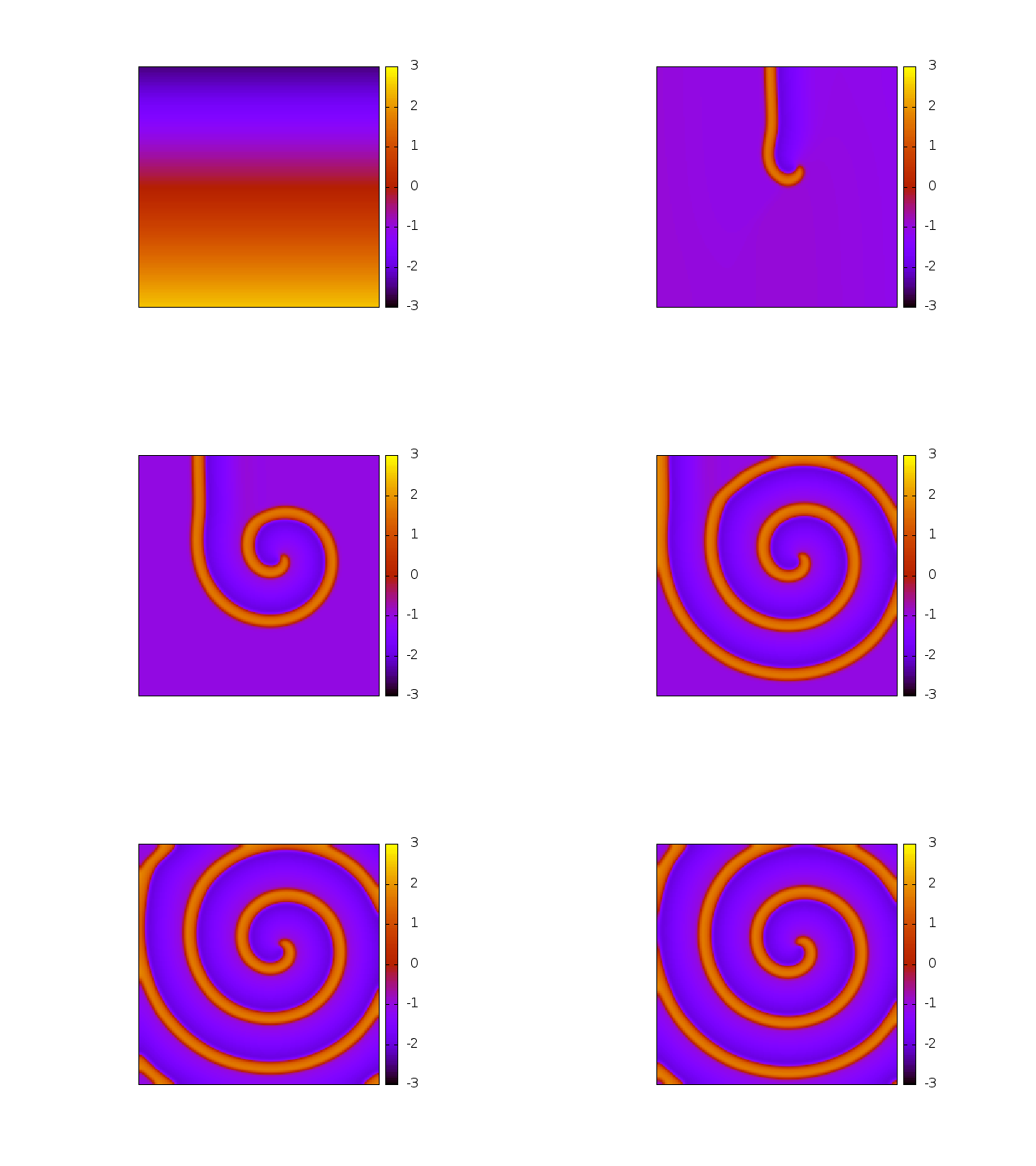
A heartbeat involves a wave of electrical activity that travels through cardiac tissue and can be recorded in an electrocardiogram. The underlying cause of some arrhythmias, such as ventricular tachycardia and ventricular fibrillation, is the formation of spiral waves that disrupt the normal behaviour of the heart. Spiral waves have their own period and can overwhelm the natural pacemaker of the heart.A simple mathematical model of electrical activity in the heart is the FitzHugh-Nagumo partial differential equation. This is a reaction-diffusion equation with spiral wave solutions.
|
A spiral wave solution of the FitzHugh-Nagumo equation. |
- Defects and the pinning of spiral waves.
- Flower patterns in spiral tip motion.
- More sophisticated models beyond the FitzHugh-Nagumo equation.
- Numerical schemes for the fast computation of spiral waves.
Mode of operation and evidence of learning
The project will revolve around learning through reading and programming in Python. Students will demonstrate their understanding by comparing their numerical results from Python codes to published data, via visualization and analysis of the output data. This will include clearly communicating the material in both written and oral formats.Prerequisites and co-requisites
Prerequisites: Programming I or equivalent Python knowledge. Mathematical Biology III is not required but may be helpful.Co-requisites: None.
Additional information
If you would like more information about this project, please contact me at p.m.sutcliffe@durham.ac.ukResources
Relevant books in the library include:The geometry of biological time by Winfree and Mathematical biology by Murray