Description
Pick any integer N greater than one. Now I ask you to place N points on a sphere so that the points are as far apart as possible. Where should you place the points? If you have chosen N=2, then placing one point at the North Pole and one point at the South Pole will obviously be a correct solution. However, if N is greater than 2 then you quickly see that it is not even clear what I meant by as far apart as possible. The question needs to be more precise.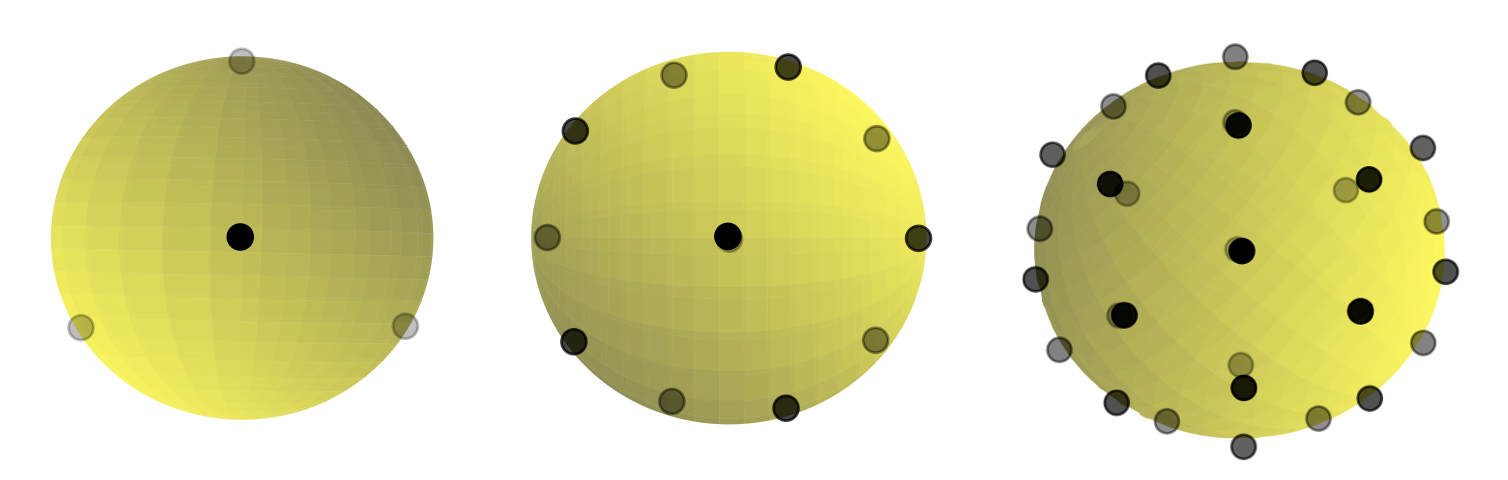
For example, I could ask that the smallest distance between any two points is as large as possible. This is known as the Tammes problem, named after the Dutch botanist who posed the problem in connection with the study of the arrangement of pores in spherical pollen grains.
Another way to get the points to be far apart from each other is to imagine that they are particles that repel each other, for example, they might be particles that all have the same electric charge. This is called the Thomson problem, named after the British physicist that discovered the electron and proposed the plum pudding model of the atom.
For some very small values of N both the Tammes and Thomson problems can be solved and have the same solution, for example, for N=4 the four points should be placed on the vertices of a regular tetrahedron. However, in general the two problems have different solutions and these can only be found by computer calculations. The image shows some solutions of the Thomson problem for N=4,12,32.
It turns out that the solutions to these (and similar) problems have applications in a range of topics from modelling viruses, to carbon chemistry, and designing golf balls.
The project is to understand and investigate the above problems by writing some computer codes in Python to find the solutions, visualize them, and to calculate some of their properties. For example, it turns out that their are some magic numbers for N at which the solution has a lot of symmetry.
Group project
By the end of the group project you will have:- Understood the formulation of the Thomson problem.
- Created a python code to find optimal numerical arrangements of points.
- Classified the symmetries of the configurations.
- Identified magic numbers of points using curve fitting.
Mode of operation and evidence of learning for the group project
The project will revolve around learning through reading and programming in Python. Students will demonstrate their understanding by comparing their numerical results from Python codes to published data, via visualization and analysis of the output data. This will include clearly communicating the material in both written and oral formats.Individual project
The individual project will build on the knowledge and skills that you have gained in the group project by exploring variations of the problem and modifying your Python code to efficiently compute numerical solutions. A few examples of topics that you may choose to investigate are:- Points in a disc.
- Central configurations.
- Genetic algorithms.
- Lennard-Jones clusters.
- The Tammes problem.
Mode of operation and evidence of learning for the individual project
The project will revolve around learning through reading and programming in Python. Students will demonstrate their understanding by comparing their numerical results from Python codes to published data, via visualization and analysis of the output data. This will include clearly communicating the material in both written and oral formats.Prerequisites and co-requisites
Prerequisites: Programming I or equivalent Python knowledge.Co-requisites: None.
Additional information
If you would like more information about this project, please contact me at p.m.sutcliffe@durham.ac.ukResources
T. Erber and G.M. Hockney, Equilibrium configurations of N equal charges on a sphere, J. Phys. A: Math. Gen. 24, L1369 (1991).L. Glasser and A.G. Every, Energy and spacings of point charges on a sphere, J. Phys. A: Math. Gen. 25, 2473 (1992).
J.R. Edmundson, The distribution of point charges on the surface of a sphere, Acta Cryst. A48, 60 (1992).
There are also many webpages dedicated to these kinds of problems. Some examples are:
The Cambridge Cluster Database
The Thomson problem on Wikipedia