|
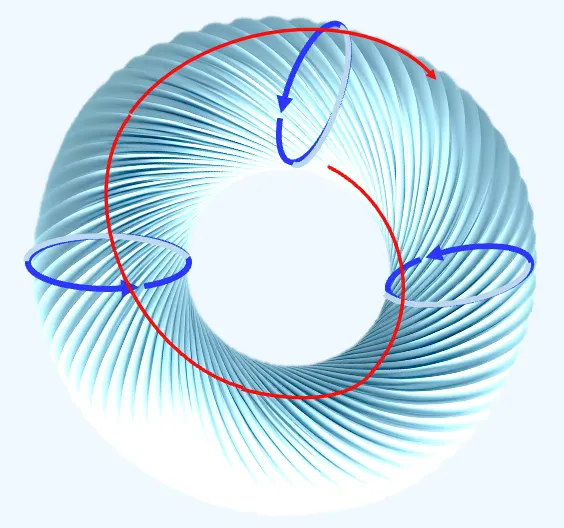
A visualisation of SO(4) by rotating 4-space in two orthogonal 2-planes. Source: Patrick R. Nicolas, A Journey into the Lie Group SO(4). |
Project Research AreaPure Mathematics DescriptionA matrix group is a group of invertible matrices. This description sounds simple enough and seems purely algebraic. In fact, you've already encountered several examples of such groups in Linear Algebra I and Algebra II. However, as we know from linear algebra, invertible matrices represent geometric motions (i.e. linear transformations) of vector spaces, so maybe it’s not so surprising that matrix groups are useful within geometry. It turns out that matrix groups are amazingly ubiquitous and pop up not only throughout mathematics, but also in many situations involving objects with symmetries, such as molecules in chemistry, particles in physics, computer graphics, general relativity, quantum computing, neural networks and data analysis. Matrix groups are special cases of Lie groups, which are simultaneously algebraic and geometric objects. The fact that they lie at the interface of the algebraic and geometric worlds means that Lie groups have been studied from many different viewpoints and provide a rich source of concrete examples of various mathematical phenomena. The goal of this project is to focus on matrix groups from a geometric viewpoint, thus acquiring hands-on experience and intuition in a setting that is less abstract than that of general Lie groups. Group ProjectThe group project will revolve around learning basic concepts and results in the study of matrix groups. By the end of the project, you will have learned
Mode of Operation and Evidence of LearningThe project will revolve around learning through reading with focus on the underlying theory, mathematical rigour, and the development of deep conceptual understanding. Students will demonstrate their understanding by solving relevant problems, exploring examples and theoretical applications of the material, and clearly communicating it in both written and oral formats. Individual ProjectThe individual project will build on the knowledge we have gained in the group project and will explore additional advanced topics. A few examples of topics you will be able to investigate are:
Mode of Operation and Evidence of LearningThe project will revolve around learning through reading with focus on the underlying theory, mathematical rigour, and the development of deep conceptual understanding. Students will demonstrate their understanding by solving relevant problems, exploring examples and theoretical applications of the material, and clearly communicating it in both written and oral formats. Prerequisites
Recommended Corequisites
Some Resources
Additional InformationIf you would like more information about this project, please contact me at martin.p.kerin@durham.ac.uk |