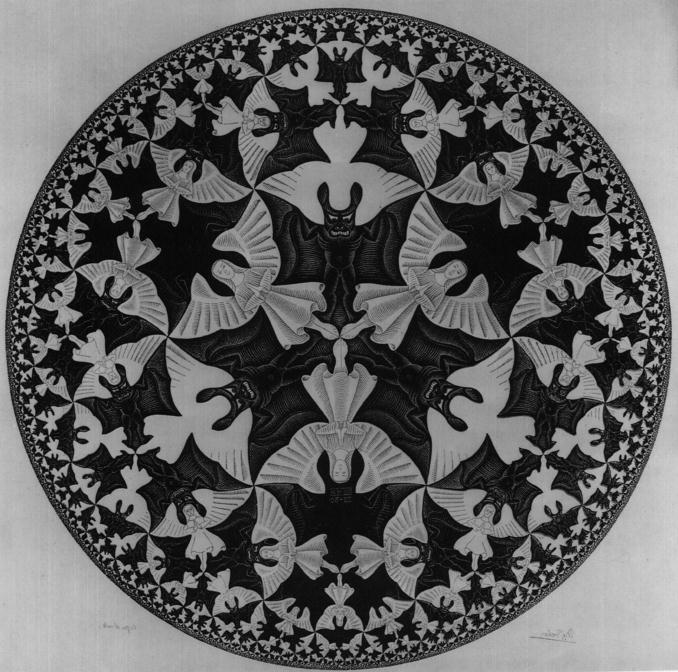
DescriptionIn an abstract setting, the hyperbolic plane may be defined using Euclid's axioms for plane geometry but with a different parallel axiom. Indeed, it was discovered by geometers investigating whether the parallel axiom was a consequence of the other axioms (and so confounded Immanuel Kant's assertion that there could be no geometry other than Euclidean geometry). We can naturally define a notion of hyperbolic distance.In practice there are several useful models of the hyperbolic plane. These can be used both for calculation and for drawing pictures. Using tiles that have the same size when measured with the hyperbolic distance function but not with Euclidean distance, we can produce tessellations of the hyperbolic plane. The symmetry groups of these tessellations include the fundamental groups of almost all surfaces and the symmetry groups of several of Escher's drawings . PrerequisitesThe tools necessary for this investigation include simple linear algebra, complex analysis, group theory and geometry. This project offers some insight into the connections of these subjects and may be slanted towards any one of them. It would be useful for students to have taken relevant pure options.The project will be supervised by John Parker. Mode of operation and evidence of learning - Group projectThis will be based on Anderson's book (see below). Each week I will set you some sections to read. To test your understanding, you should atempt the exercises at the end of the chapter. The following week we will go through the material together in a group meeting. I expect you to come with questions on the material and/or the ecercises you will have attempted. I will (attempt to) answer all the questions you had while doing the reading. By the end of this phase of the project you will learn the basics of the hyperbolic plane and its isometries. Solving the exercises each week will help you gauge your own learning. Explaining your ideas to other members of the group will reinforce this learning.Mode of operation and evidence of learning - Individual projectIn this stage, you will build on the material you learned in the group project phase, specialising on a particular topic. In this phase I will meet with you individually each week to discuss your progress and to suggest further reading or problems to attempt. Your progress in these tasks will be evidence of your learning. There are many possible topics and I will try to assign one to you that fits with your own interests. Possible topics include:NoteI plan to be away from Durham in the first half of Epiphany Term and so we will meet online then. Otherwise meetings will be in person.ResourcesWe will use the book James W Anderson Hyperbolic Geometry Springer 1999. Another useful book is Svetlana Katok Fuchsian Groups Chicago UP 1992. See also the wikipedia entry hyperbolic geometry for a good description or hyperbolic tessellations for some nice pictures. |
email: J R Parker