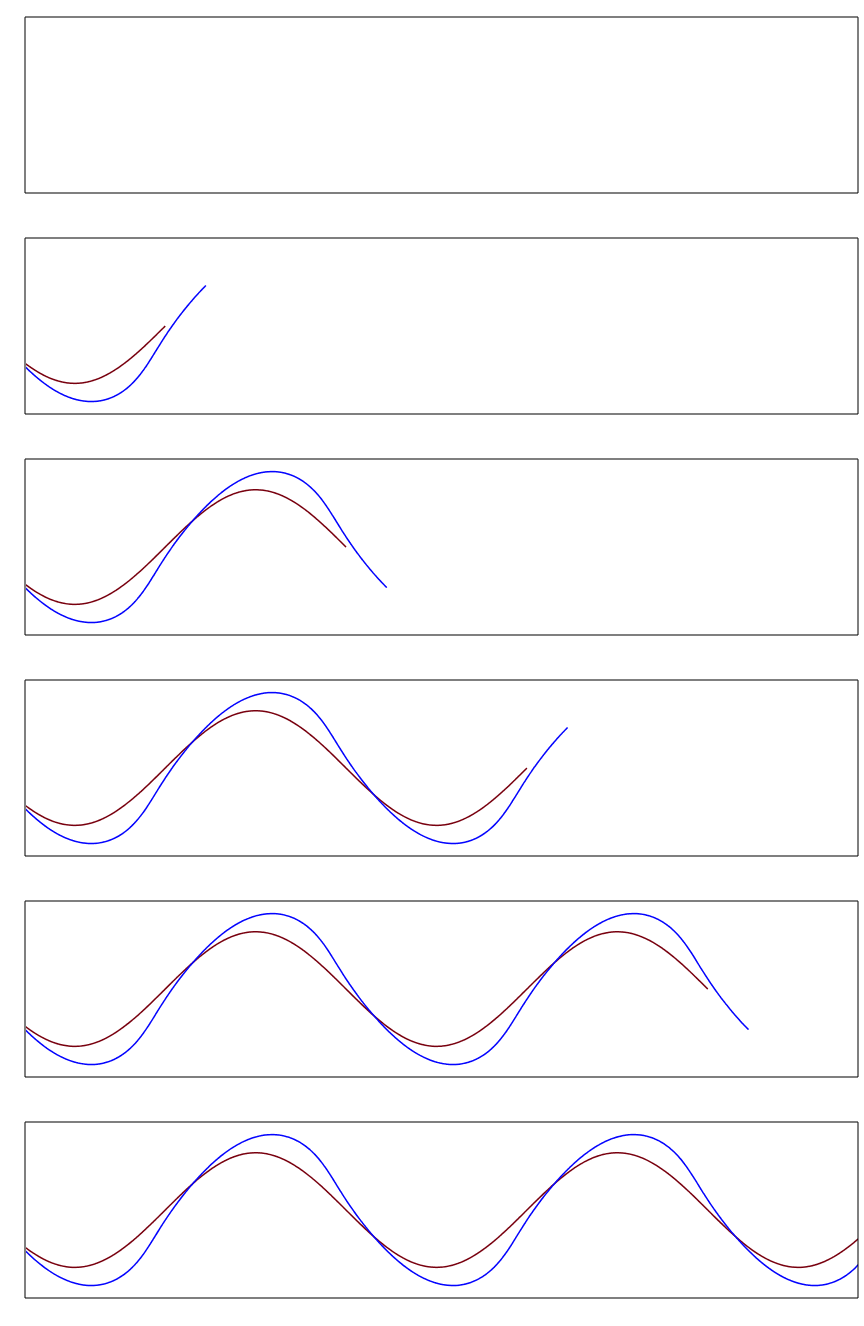
Description
This project begins with the following problem: you observe a pair of tracks in the snow, made some time before by the front and rear wheels of a bicycle:
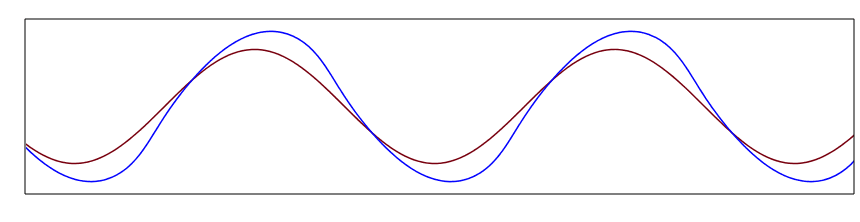
The question is, on the basis of the shape of these tracks alone, can you tell which way the bicycle was travelling - left to right, or right to left? This was famously posed, and then answered incorrectly, in the Sherlock Holmes short story "The Adventure of the Priory School".
The key to the correct answer is the fact that it is the front wheel that does the steering, while the rear wheel always points along the frame towards the front wheel. This tells you something about the tangent line to the rear-wheel track: at a fixed distance in the forward direction, it must hit the front-wheel track. Before scrolling down, you might try to use this observation to figure out which of the two tracks above must correspond to the front wheel, and then, given that, which direction the bicycle was travelling.
This is just the first of a whole sequence of questions with unexpected links to other areas of mathematics such as soliton theory and elliptic functions, and these will be the focus of the individual project. For example, might there be 'ambiguous' pairs of tracks for which neither you nor even Sherlock Holmes could figure out the bicycle's direction of travel? Straight lines and circles are obvious examples, but it turns out that there are more, and that these provide solutions to another famous problem: are there any non-circular cross-sections for a cylindrical body which would allow it to float in any orientation? Another topic which is still being explored concerns whether a bicycle can move in such a way that its front and rear tires trace out the same track - the answer turns out to be yes, but it's complicated!
Group project
For the group project we will explore the basic geometry of the bicycle track problem, and develop python programs to solve it numerically. Time permitting we will also investigate the floating body problem.
Mode of operation and evidence of learning for the group project
Students will develop an understanding of the problem through reading relevant papers and making their own numerical and analytic calculations, and then communicate this in written and oral formats.
Individual project
For the individual projects students will explore particular aspects of the problem in greater detail.
Mode of operation and evidence of learning for the individual project
Students will investigate their chosen aspect of the problem through reading relevant papers and making their own calculations, and then communicate their results in written and oral formats.
Prerequisites
Some familiarity with ordinary differential equations, and a willingness to make numerical explorations using a computer.
Resources
- The Sherlock Holmes story is here, and its mathematical failings are discussed in, for example, the short article "Sherlock Holmes and the Bicycle tracks".
- For some animations of ambiguous tracks, see here.
- The bicycle track problem has been discussed in a number of articles by Tabachnikov and collaborators. See for example here and here.
- Links with the floating-body problem are described here.
- A couple of recent papers on unibike curves, for which front and rear tires trace the same path, are here and here.
The answer to the problem at the top of the page:
For the tracks plotted above, the blue curve must be the front wheel, and the direction of travel is from left to right: