Kummer Surfaces
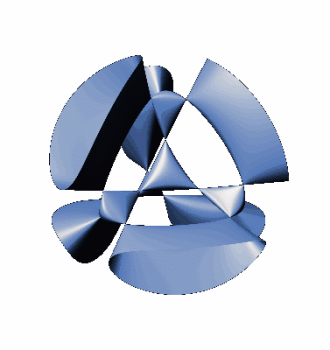
The Kummer surface S is a surface of degree 4 in projective 3-space with
16 nodes. It has a symmetry group G = (Z/2)4, of which the nodes form
an orbit.
Note that S is made up of 8 `tetrahedral' pieces: 3 of these cross the
plane at infinity, but the group G, which acts in projective space, is
unimpressed by this and does not distinguish them.
The Kummer surface lives at the crossroads of several geometrical
theories:
- 16 is the maximum number of singular points that a quartic surface in
3 dimensions can have.
- the equation of S depends on 4 parameters which satisfy a cubic
equation. So actually, S depends on a cubic hypersurface M in 4
dimensions.
- M has 10 nodes---which is the maximum number a cubic 3-fold can have.
- as well as 16 nodes, there are 16 planes tangent to S along a conic
section. Each plane contains 6 nodes and each node lies on 6 of the
planes. The 16 planes represent the nodes of the dual surface
parametrising the tangent planes of S.
- S is the caustic locus of a line complex in 3 dimensions of degree 2.
(In fact it was first discovered in the study of optics.)
- S is the Jacobian of a curve of genus 2 (more precisely: the image of
the Jacobian using 2nd order theta functions).
- S is the set of strictly semistable vector bundles of rank 2 on a
Riemann surface of genus 2. (From this point of view, S behaves as the
`singular locus' of 3 dimensional space!)
- A Riemann surface of genus 2 depends on 3 parameters, or `moduli'. The
moduli space is (essentially) the cubic 3-fold M.